
EYFS Curriculum
Our Early Years Foundation Stage
At St Cecilia’s Catholic Primary Schoolour EYFS provision is designed to nurture curiosity, creativity and a lifelong love of learning. We provide a stimulating, supportive and inclusive environment where every child feels valued, secure and celebrated, helping them to grow in confidence and develop as enthusiastic, independent learners.
Our enabling environments promote communication and language, encouraging children to express themselves, build relationships and develop their understanding through meaningful interactions and play. Through carefully planned, hands-on experiences, children are encouraged to explore, investigate, problem-solve and discover, bringing out the very best in every child.
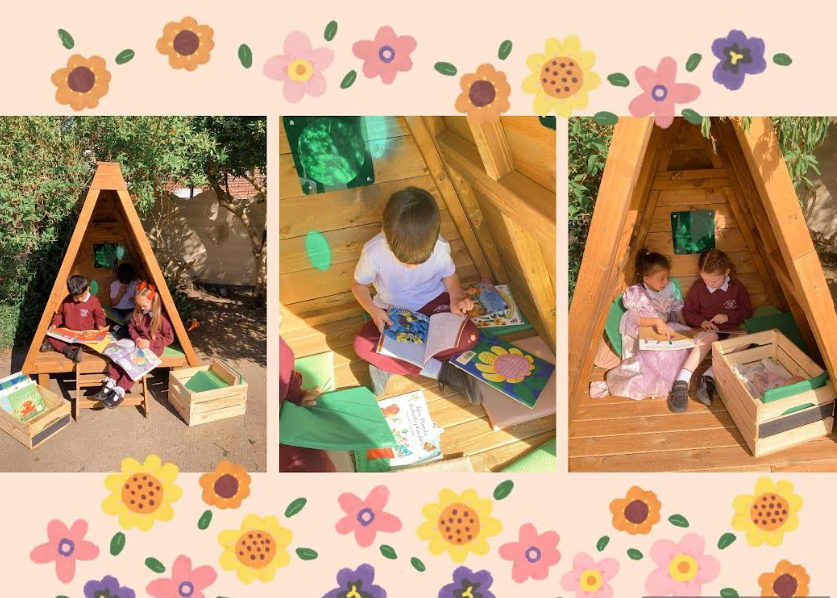
We value learning outdoors, providing opportunities for children to explore, take risks, develop their independence and learn about the world around them. Our children are encouraged to wonder, question and make connections as they learn through real-life experiences.
Our curriculum is made up of the seven areas of learning set out in the EYFS Framework. These are split into three prime areas and four specific areas.
Prime Areas
Personal, Social and Emotional Development – Children learn to understand and manage their emotions, build positive relationships, develop confidence and become increasingly independent.
Communication and Language – Children are supported to become confident communicators, developing their listening, attention, understanding and speaking skills.
Physical Development – Children develop their gross and fine motor skills, coordination, balance, strength and control, alongside an understanding of healthy lifestyles.
Specific Areas
Literacy - Children develop a love of books, storytelling and reading, alongside the foundations of writing.
Mathematics – Children develop a strong understanding of number, numerical patterns, shape, space and measure.
Understanding the World – Children develop their understanding of people, communities, cultures, the natural world, technology and the world around them.
Expressive Arts and Design - Children are encouraged to express themselves creatively through art, music, movement, role play and imaginative experiences.
Although the seven areas are described separately, they are not taught in isolation. Our EYFS curriculum is carefully planned so that children can develop skills across several areas through rich, meaningful experiences.
Above all, our EYFS is a place where children can learn, explore, create and thrive, building strong foundations for their future learning and development.
At the heart of our EYFS provision is the belief that children learn best when they are happy, engaged and curious. We combine high-quality adult-led teaching with carefully planned continuous provision, allowing children to revisit, practise and apply what they have learned.
Outdoor Learning in Reception:
In EYFS, effective pedagogy is a mix of different approaches. Children learn through play, by adults modelling, by observing each other, and through guided learning and direct teaching.
Our EYFS practitioners carefully organise enabling environments for high-quality play.
Our children in the early years also learn through group work, when practitioners guide their learning.
A well-planned learning environment, indoors and outside, is an important aspect of our pedagogy here at St. Cecilia’s Catholic Primary School.


Starting in Reception
Starting school can be a bit scary for your little one, watch this clip together as Topsy and Tim talk about their first day at school and explain why there's nothing to worry about. Click on the link below to watch this video.
School Readiness
Helping your child feel ready for school is a team effort — everything you do at home, alongside the care and learning they receive in childcare and early years education play a big part.
From chatting and reading together to encouraging independent skills like dressing or tidying up, all the little things you do each day help your child grow in confidence and curiosity. These simple moments build the foundation they need to start Reception.
Last updated: May, 2026. Taken from: https://beststartinlife.gov.uk/school-readiness/
More information and guidance to support your child starting Reception can be found on: https://startingreception.co.uk/
More supportive documents can be found by clicking on the links below:
Toothbrushing Guide
https://startingreception.co.uk/toothbrushing/
Potty Training Guide
https://startingreception.co.uk/potty-training/
|
Parents and carers |
|
|
School websites |
Explore your child’s school website. You will be able to find information about usual daily routines, curriculum and school uniforms. You will also be able to find contact details for the school here should you need them. |
|
Visit the school |
Take a walk or drive to the school. Exploring the route and talking to children about where the school is and who will be taking them there each day can really help them to understand and start to get excited about it. |
|
Talk about change |
For some children, starting school can be a very worrying and frightening time. Talk to your child about times when things have changed, if you have ever moved house, for example, or when they first went to a friend or relative's house. Some children will need lots of reassurance that this is a new experience but an exciting one. |
|
Online resources |
There are lots of lovely resources available online to support you and your child as you prepare for reception. CBBC is a great place to find videos, stories and activities about starting school: https://www.bbc.co.uk/cbeebies/watch/topsy-tim-top-tips-school?collection=starting-school-curation |
|
Support independence |
Encourage your child to start doing things for themselves as much as possible. If your child can use the toilet, wash their hands, wipe their nose and put on their own coat and shoes by themselves, this will be a great help to them as they start school and become more independent. |